

Configure a cluster
|
IMPORTANT
There is usually no need to change cluster configuration parameters. You can leave all parameters at the default values.
|
After creation a new cluster, you can configure it by performing the following steps:
-
Select a cluster on the Clusters page. To do this, click a cluster name in the Name column.
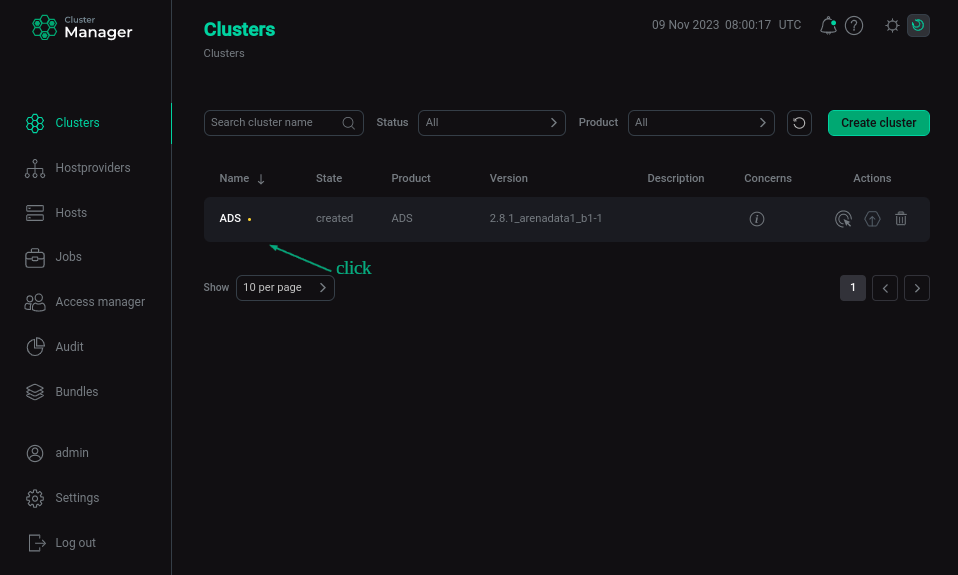 Select a cluster
 -
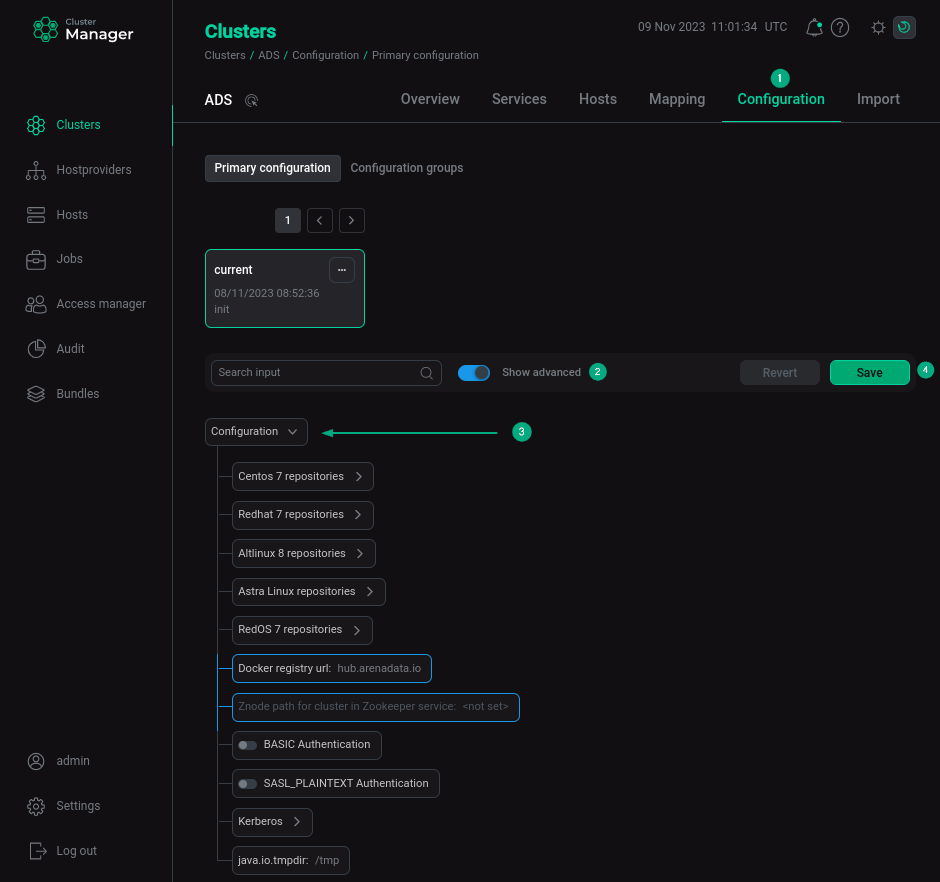
Open the Configuration tab on the cluster page. The Configuration tab includes the following sections: Primary configuration, Configuration groups, Ansible settings.
-
Fill in all necessary parameters on the selected tab and click Save.
Primary configuration
The Configuration → Primary configuration tab allows you to configure the general cluster settings.
Cluster configuration parameters are listed below:
-
Reliability control — parameters of this section are intended to set the timeout of the DNF software package manager unlocking wait. Displayed if the Show advanced switch is activated. In Ubuntu, after the host reboot, automatic update starts, which locks DNF.
Name Description Default value retries
The maximum number of retries
80
delay
The time delay between retries (in seconds)
30
timeout
Timeout for network ports checks (in seconds)
7200
-
Paths to the repositories that are used during the installation process depending on the cluster operating system (Ubuntu 22, Altlinux 10, Astra Linux, RedOS 7). Only the marked repositories are registered on the cluster servers.
RepositoriesRepository name Parameter Description Default value monitoring
desc
Repository description
Monitoring components url
url
Arenadata repository path
Specified depending on the operating system
enabled
Enables use of the repository
True
Add property
In this field, it is possible to define values for other parameters
—
ADS
desc
Repository description
ADS repository
url
Arenadata repository path
Specified depending on the operating system
enabled
Enables use of the repository
True
Add property
In this field, it is possible to define values for other parameters
—
prometheus_repo
desc
Repository description
Prometheus repository
url
Arenadata repository path
Specified depending on the operating system
enabled
Enables use of the repository
True
Add property
In this field, it is possible to define values for other parameters
—
arenadata_java
desc
Repository description
Arenadata repository for OpenJDK
url
Arenadata repository path
Specified depending on the operating system
enabled
Enables use of the repository. If set to
Truebefore the Install, Add/Remove components, or Update action for a cluster or service, the latest version of Java 21 will be installed on hostsTrue
Add property
In this field, it is possible to define values for other parameters
—
ranger plugins
desc
Repository description
Arenadata Ranger plugins repository
url
Arenadata repository path
Specified depending on the operating system
enabled
Enables use of the repository
True
Add property
In this field, it is possible to define values for other parameters
—
-
Precheck packages — enables package availability check before installation.
-
Docker registry url — specifies the location of Arenadata Docker Registry. Displayed if the Show advanced switch is activated.
-
Znode path for cluster in Zookeeper service — Znode path for the ADS cluster in the Zookeeper service. Displayed if the Show advanced switch is activated.
-
BASIC Authentication — configuration for BASIC authentication.
For a description of enabling authentication, see the article Basic authentication.
-
SASL_PLAINTEXT Authentication — configuration for SASL PLAINTEXT authentication.
For a description of enabling authentication, see the article SASL PLAINTEXT.
-
Kerberos — configuration for Kerberos authentication.
The description of enabling authentication is given in the articles:
-
java.io.tmpdir — a Java system property that determines where the JVM writes temporary files.
-
Custom Java config — a template for a custom configuration file that determines the versions of Java used for the cluster and services, as well as installation paths. This parameter can be used to explicitly specify the Java version. Starting from ADS 3.9.1.2.b1, it is used to explicitly define the Java version. For more details, see Software Requirements — Java.
-
The
defaultsection configures the default behavior when working without specifying a particular service. -
The
autodetectsection defines the algorithm for automatically detecting different versions of Java. For each version (currently, 21), the following is configured:-
env_var— a special environment variable for this version (e.g.JAVA21_HOME). -
paths— a list of paths to search for the Java installation.
-
-
The
servicessection defines the services for which specific versions of Java are configured. The settings are stored in separate YAML files.
AD runtime utils config templatedefault: runtimes: java: version: "{{ java_default_version }}" env_var: JAVA_HOME autodetect: runtimes: java: "8": env_var: JAVA8_HOME paths: - /usr/java/jdk1.8 - /usr/java/jre1.8 - /usr/lib/jvm/j2sdk1.8-oracle - /usr/lib/jvm/j2sdk1.8-oracle/jre - /usr/lib/jvm/java-8-oracle - /usr/lib/jdk8-latest - /usr/lib/jvm/java-1.8.0 - /usr/lib/jvm/java-1.8.0-oracle - /usr/lib/jvm/bellsoft-java8-amd64 - /usr/lib/jvm/java-arenadata-openjdk-8 "17": env_var: JAVA17_HOME paths: - /usr/lib/jvm/bellsoft-java17-amd64 - /usr/lib/jvm/bellsoft-java17 - /usr/lib/jvm/liberica-jdk-17* - /usr/lib/jvm/liberica-jre-17* - /usr/lib/jvm/zulu-17* - /usr/lib/jvm/temurin-17* - /usr/lib/jvm/adoptopenjdk-17* - /usr/lib/jvm/jdk-17* - /usr/lib/jvm/java-17* - /usr/lib/jvm/openjdk-17* - /usr/lib/jvm/openjdk-17* - /opt/java/bellsoft-java17-amd64 - /opt/java/temurin-17* - /usr/local/java/bellsoft-java17-amd64 - /usr/lib/jvm/java-arenadata-openjdk-17 - /usr/lib64/jvm/java-17* "21": env_var: JAVA21_HOME paths: - /usr/lib/jvm/java-21* - /usr/lib/jvm/jdk-21* - /usr/lib/jvm/java-arenadata-openjdk-21 "23": env_var: JAVA23_HOME paths: - /usr/lib/jvm/bellsoft-java23-amd64 - /usr/lib/jvm/bellsoft-java23 - /usr/lib/jvm/liberica-jdk-23* - /usr/lib/jvm/liberica-jre-23* - /usr/lib/jvm/zulu-23* - /usr/lib/jvm/temurin-23* - /usr/lib/jvm/adoptopenjdk-23* - /usr/lib/jvm/jdk-23* - /usr/lib/jvm/java-23-openjdk - /usr/lib/jvm/openjdk-23* - /opt/java/bellsoft-java23-amd64 - /opt/java/temurin-23* - /usr/local/java/bellsoft-java23-amd64 - /usr/lib/jvm/java-arenadata-openjdk-23 "24": env_var: JAVA24_HOME paths: - /usr/lib/jvm/bellsoft-java24-amd64 - /usr/lib/jvm/bellsoft-java24 - /usr/lib/jvm/liberica-jdk-24* - /usr/lib/jvm/liberica-jre-24* - /usr/lib/jvm/zulu-24* - /usr/lib/jvm/temurin-24* - /usr/lib/jvm/adoptopenjdk-24* - /usr/lib/jvm/jdk-24* - /usr/lib/jvm/java-24-openjdk - /usr/lib/jvm/openjdk-24* - /opt/java/bellsoft-java24-amd64 - /opt/java/temurin-24* - /usr/local/java/bellsoft-java24-amd64 - /usr/lib/jvm/java-arenadata-openjdk-24 services: ZOOKEEPER: path: /etc/zookeeper/conf/zookeeper-java.yaml KAFKA: path: /etc/kafka/conf/kafka-java.yaml KAFKA_CONTROLLER: path: /etc/kafka/conf/kafka-controller-java.yaml KAFKA_CONNECT: path: /etc/kafka-connect/config/kafka-connect-java.yaml CRUISE_CONTROL: path: /etc/cruise-control/conf/cruise-control-java.yaml KSQL: path: /etc/ksqldb/ksqldb-java.yaml KAFKA_REST: path: /etc/kafka-rest/kafka-rest-java.yaml SCHEMA_REGISTRY: path: /etc/schema-registry/schema-registry-java.yaml NIFI: path: /etc/nifi/conf/nifi-java.yaml NIFI_REGISTRY: path: /etc/nifi-registry/conf/nifi-registry-java.yaml MINIFI: path: /etc/minifi/conf/minifi-java.yaml MINIFI_C2: path: /etc/minifi-c2/conf/minific2-java.yaml NIFI2: path: /etc/nifi2/conf/nifi-java.yaml NIFI2_REGISTRY: path: /etc/nifi2-registry/conf/nifi-registry-java.yaml -
-
Cluster UUID — displays the universally unique identifier of the cluster.
Configuration groups
The Configuration → Configuration groups tab is designed to set cluster configuration groups.
Ansible settings
The Configuration → Ansible settings tab allows you to set Ansible configuration options at the cluster level. The tab is available starting with ADCM 2.2.0.
| Name | Description | Default |
|---|---|---|
forks |
The number of parallel processes to spawn when communicating with remote hosts |
5 |