

Configure a cluster
|
IMPORTANT
There is usually no need to change cluster configuration parameters. You can leave all parameters at the default values.
|
After creation a new cluster, you can configure it by performing the following steps:
-
Select a cluster on the Clusters page. To do this, click a cluster name in the Name column.
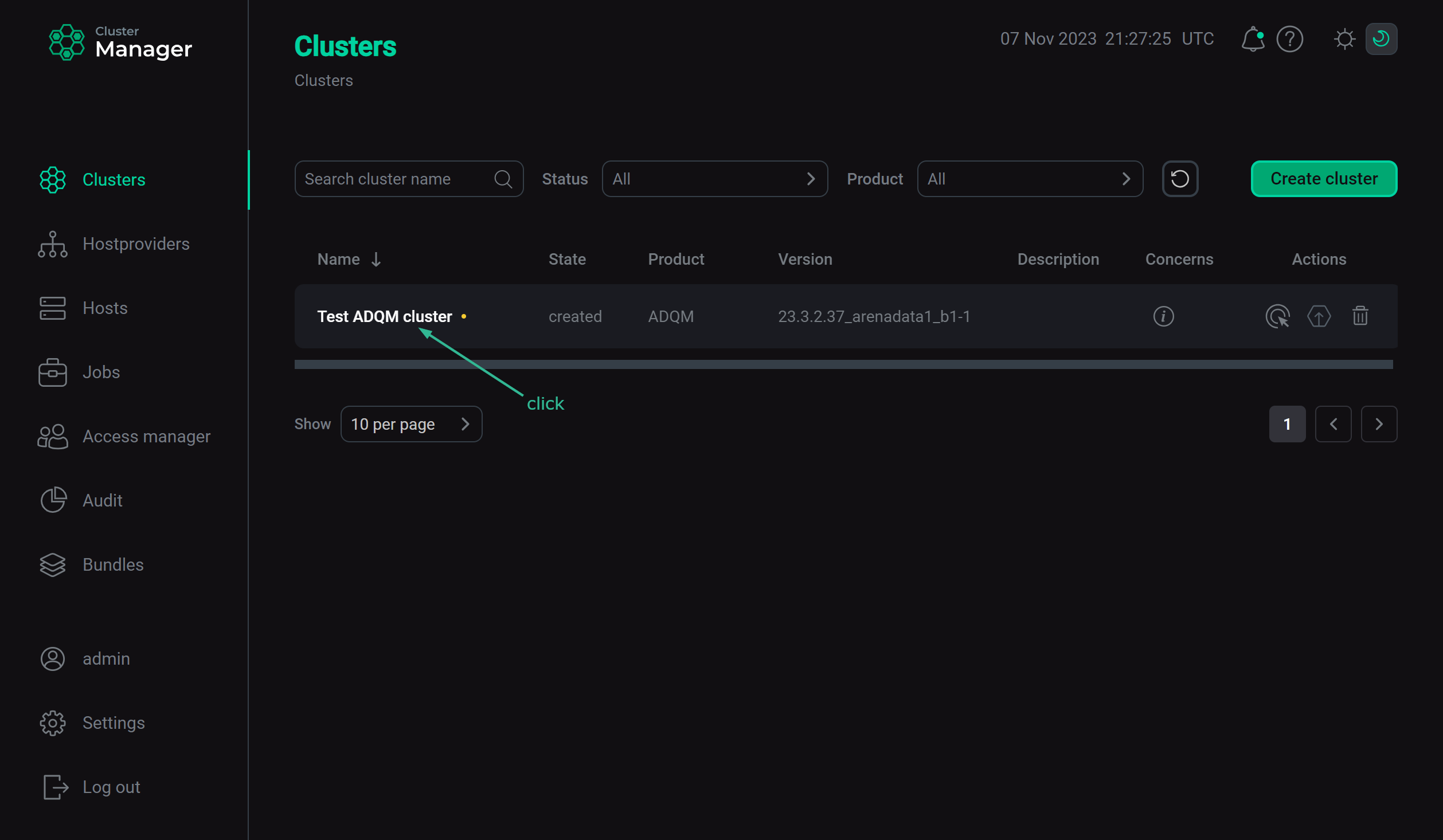 Select a cluster
 -
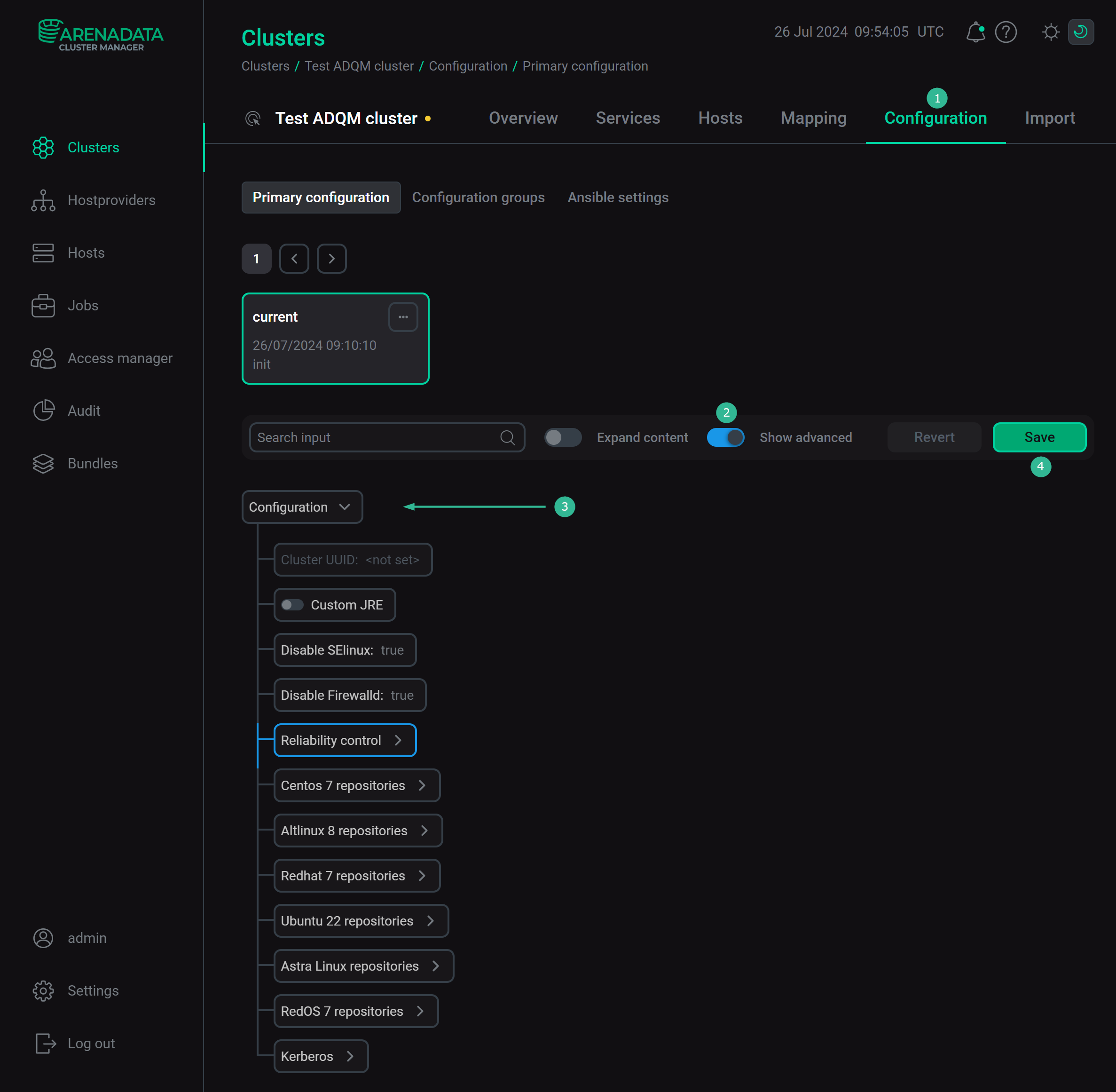
Open the Configuration tab on the cluster page. The Configuration tab includes the following sections: Primary configuration, Configuration groups, Ansible settings.
-
Fill in all necessary parameters on the selected tab and click Save.
Primary configuration
The Configuration → Primary configuration tab allows you to configure the general cluster settings.
ADQM cluster configuration parameters are listed below:
-
Custom JRE — the switcher that indicates whether to use a custom path to Java for ADQM services. When the switcher is activated, the JAVA_HOME field becomes available — enter a work Java path in this field. No system JRE packages will be installed.
-
Disable SElinux — disables SElinux on hosts of the cluster (available starting with ADQM 22.8.4.7.1.b1).
-
Disable Firewalld — disables firewalld on hosts of the cluster (available starting with ADQM 22.8.4.7.1.b1).
-
Network topology group — cluster network settings that define default values for the Listen host configuration and Interserver listen host configuration parameters of the ADQMDB, Clickhouse Keeper, and Chproxy services (for the description of value binding types, refer to the description of the Listen host configuration service parameters in the Configuration parameters article). Configuration of network parameters at the cluster level is available starting with ADQM 26.3.3.20.1.b1.
-
Reliability control — the section with the following settings (visible if the Show advanced option is enabled):
-
retries — number of retries for cluster operations (
3by default); -
delay — delay between retries in seconds (
10by default); -
timeout — timeout for checks of network ports in seconds (
60by default).
-
-
Paths to the repositories that are used during the installation process — depending on the cluster operating system (Alt Linux, Ubuntu, Astra Linux, or RED OS):
-
monitoring — repository required to install monitoring;
-
zookeeper_repo — repository required to install Arenadata Zookeeper;
-
ADQM — repository required to install ADQM;
-
prometheus_repo — repository required to install Prometheus;
-
ADQM_arenadata_enterprise — repository required to install the Enterprise edition of ADQM.
-
-
Kerberos — configuration for Kerberos authentication (some parameters are visible only with the Show advanced option enabled).
Configuration groups
The Configuration → Configuration groups tab is designed to set cluster configuration groups.
Ansible settings
The Configuration → Ansible settings tab allows you to set Ansible configuration options at the cluster level. The tab is available starting with ADCM 2.2.0.
| Name | Description | Default |
|---|---|---|
forks |
The number of parallel processes to spawn when communicating with remote hosts |
5 |
|
NOTE
During offline installation these parameters are ignored. The data stored locally in the Enterprise Tools cluster is used instead. |