ADPG
| Parameter | Description | Default value |
|---|---|---|
Data directory |
Directories used to store data on ADPG hosts |
/pg_data1 |
|
TIP
You can obtain the optimal parameter values to achieve the best ADPG performance using the Collect recommendations action of the ADPG service.
|
| Parameter | Description | Default value |
|---|---|---|
listen_addresses |
TCP/IP addresses on which the server listens for connections from client applications |
* |
port |
TCP port the server listens on |
5432 |
max_connections |
Maximum number of concurrent connections to the database server |
100 |
shared_buffers |
Amount of memory the database server uses for shared memory buffer. A reasonable starting value is 25% of the memory in your system |
2048 MB |
max_worker_processes |
Maximum number of background processes that the system can support |
23 |
max_parallel_workers |
Maximum number of workers that the system can support for parallel operations |
4 |
max_parallel_workers_per_gather |
Maximum number of workers that can be started by a single Gather or Gather Merge node |
2 |
max_parallel_maintenance_workers |
Maximum number of parallel workers that can be started by a single utility command |
2 |
effective_cache_size |
Sets the ADPG query planner’s assumption about the effective size of the disk cache available to a single query. This is factored into estimates of the cost of using an index. The higher this value, the more likely the index scan will be applied. The lower this value, the more likely the sequential scan will be selected |
6144 MB |
maintenance_work_mem |
Memory limit for maintenance operations. Increasing the value for this parameter can improve the performance of operations for cleaning and restoring the database from a copy |
1024 MB |
work_mem |
Non-shared memory limit used for internal operations when the server executes queries (for example, queries to temporary tables) before temporary files on the disk are used. This limit acts as simple resource control, preventing the host from going into swapping due to overallocation. Since the allocated memory is non-shared memory, large and complex requests can exceed the specified limit |
5242 kB |
min_wal_size |
Until WAL disk usage stays below the |
1024 MB |
max_wal_size |
Memory limit to which the log size can grow between automatic checkpoints. Increasing this setting may increase the recovery time after a failure. The specified limit can be exceeded automatically with a high load on ADPG |
4096 MB |
wal_keep_size |
Specifies the minimum size of segments retained in the pg_wal directory, in case a standby server needs to fetch them for streaming replication. If a standby server connected to a sending server falls behind by more than |
0 MB |
huge_pages |
Defines whether huge pages can be requested for the main shared memory area. Possible values:
|
try |
superuser_reserved_connections |
Number of connection "slots" that are reserved for PostgreSQL superuser connections |
3 |
timescaledb.max_background_workers |
Maximum number of background worker processes allocated to TimescaleDB |
16 |
wal_buffers |
Amount of shared memory used for WAL data that has not yet been written to disk |
16 MB |
default_statistics_target |
Default statistics target for table columns without a column-specific target set via |
100 |
random_page_cost |
Planner’s estimate of the cost of a non-sequentially-fetched disk page |
1.1 |
checkpoint_completion_target |
Target time of checkpoint completion as a fraction of total time between checkpoints |
0.9 |
max_locks_per_transaction |
The shared lock table tracks locks on |
128 |
autovacuum_max_workers |
Maximum number of autovacuum processes (excluding the autovacuum launcher) that are allowed to run at the same time |
10 |
autovacuum_naptime(seconds) |
Minimum delay between autovacuum runs on any given database. In each round, the autovacuum daemon examines the database and executes the |
10 |
default_toast_compression |
Default TOAST compression method for values of a compressible column. Possible values: |
lz4 |
effective_io_concurrency |
Number of concurrent disk I/O operations that can be executed simultaneously. Raising this value will increase the number of I/O operations that a PostgreSQL session attempts to initiate in parallel |
256 |
jit |
Specifies whether PostgreSQL may use JIT compilation, if it is available |
off |
logging_collector |
Enables the logging collector — a background process that captures log messages sent to stderr and redirects them into log files |
Enabled |
log_directory |
Directory that contains log files. It can be specified as an absolute path, or relative to the ADPG cluster data directory |
log (the absolute path is /pg_data1/adpg14/log) |
log_filename |
Log file name pattern. A value can include strftime %-escapes to define time-varying file names. If you specify a file name pattern without escapes, use a log rotation utility to save disk space |
postgresql-%a.log |
log_rotation_age |
Maximum period of time to use a log file, after which a new log file is created. If this value is specified without units, it is taken as minutes. Set |
1d |
log_rotation_size |
Maximum size of a log file. After a log file reaches the specified size, a new log file is created. If the value is set without units, it is taken as kilobytes. Set |
0 |
log_min_messages |
Minimum severity level of messages to be written to a log file. Possible values are |
warning |
log_min_error_statement |
Specifies which SQL statements that cause errors are logged. Possible values are |
error |
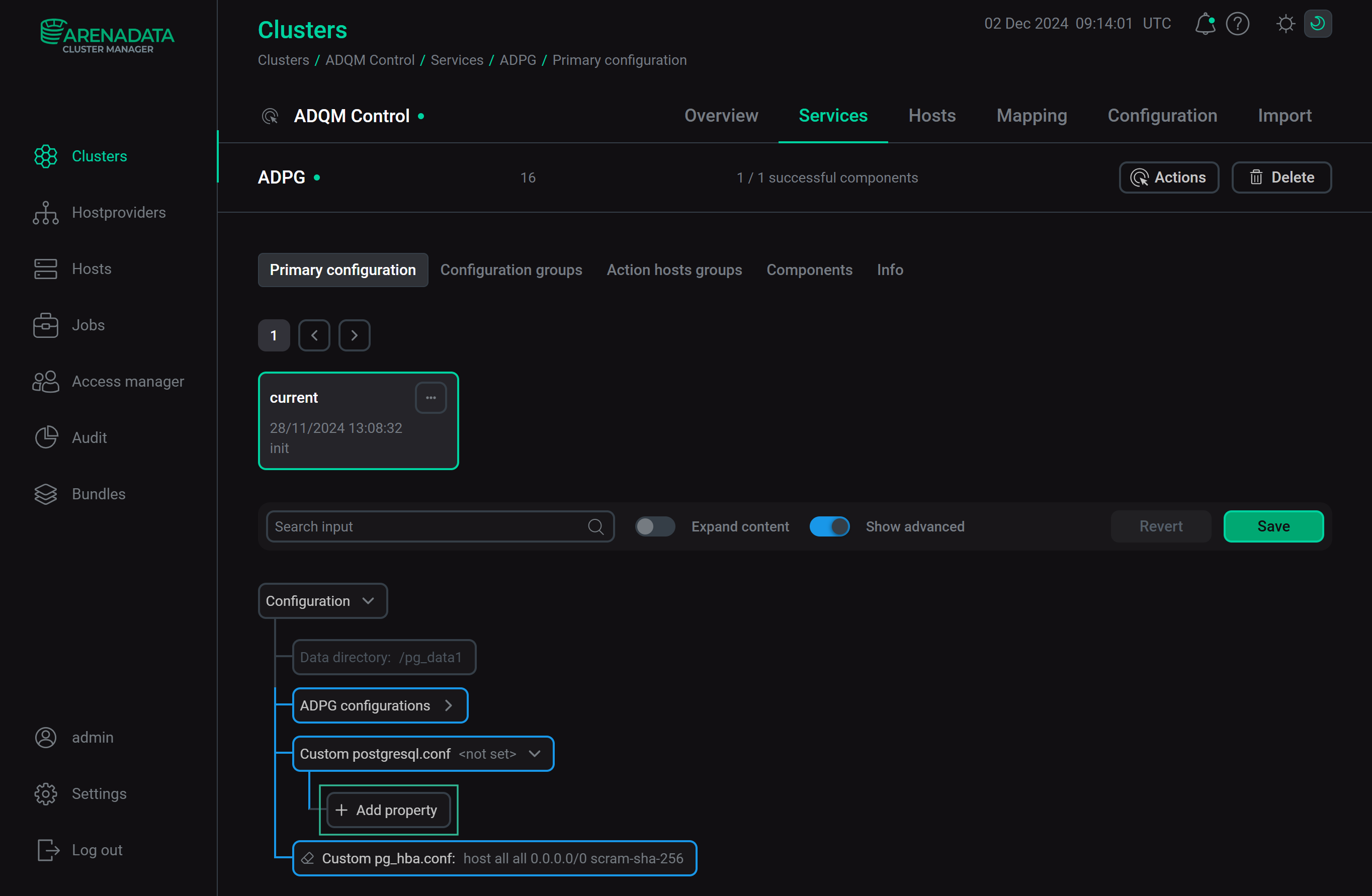
In the Custom postgresql.conf section, you can set additional parameters to be written to the postgresql.conf file. To add a parameter, click Add property.
In the window that appears, enter a parameter (its name and value) and click Apply.
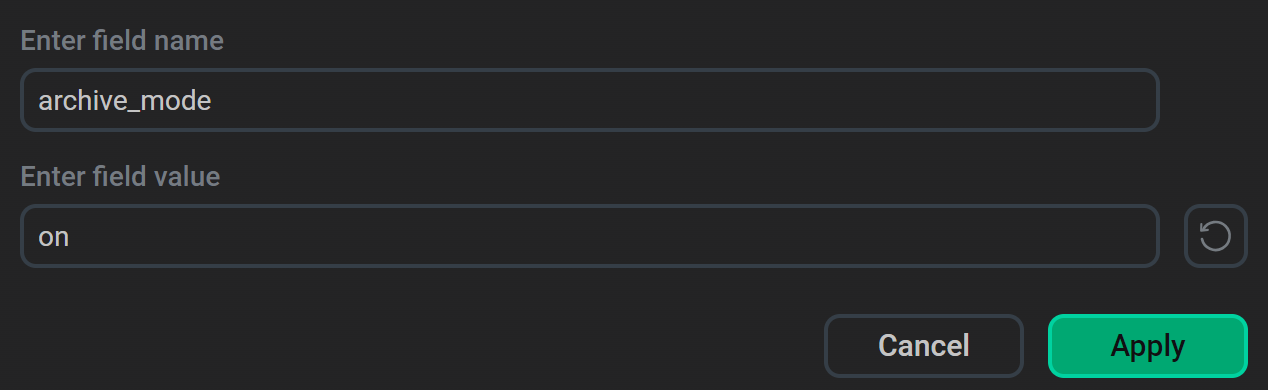
You can add multiple parameters.
Section for setting the shared_preload_libraries parameter of the postgresql.conf configuration. ADQM Control requires the timescaledb and timescaledb_toolkit extensions. If you need to add other extensions (for example, pg_stat_statements), use the icon 
 .
.
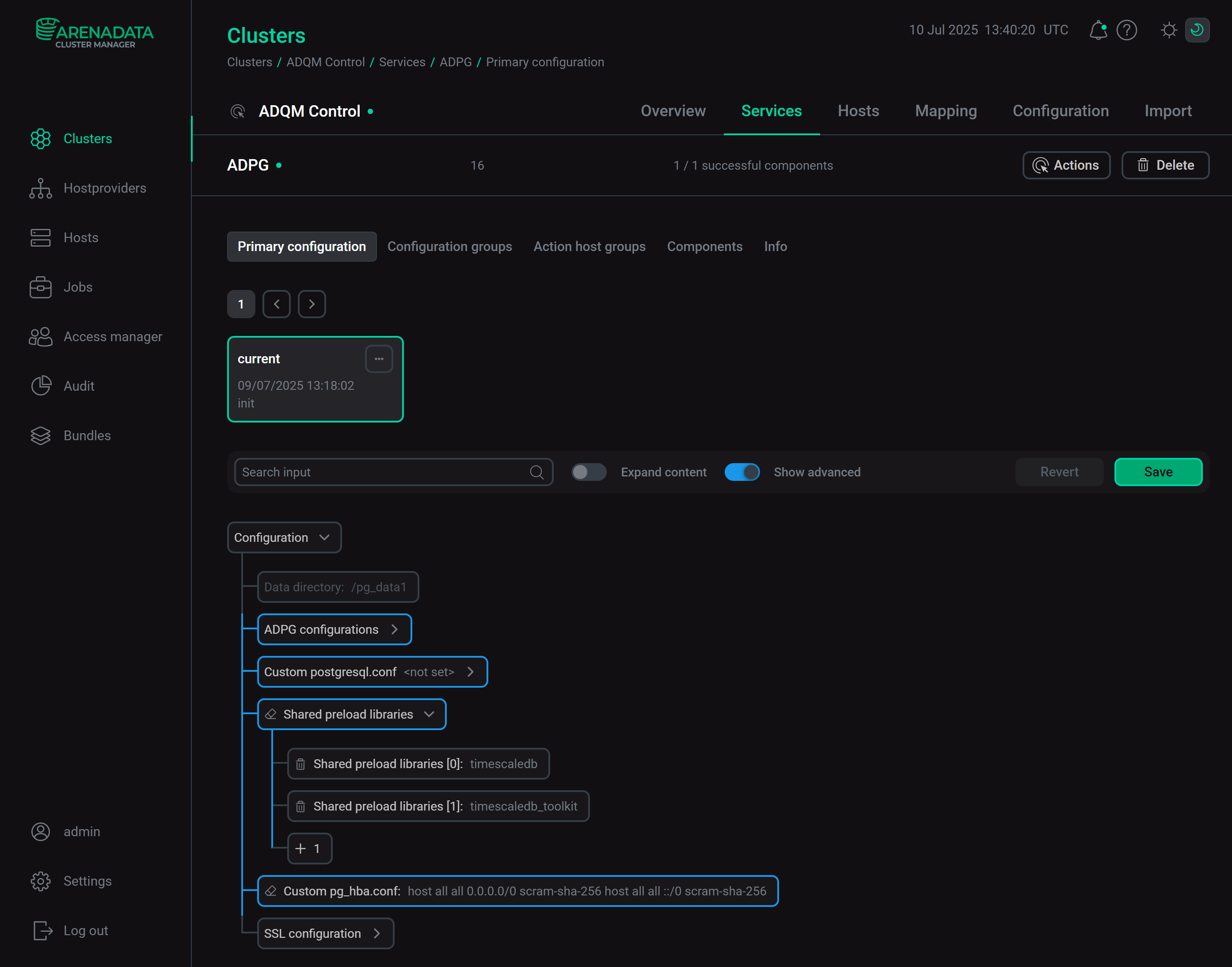
This field allows you to add records to the pg_hba.conf file that controls client authentication.
|
NOTE
For more information on SSL encryption support in ADQM Control, see the SSL encryption article. |
| Parameter | Description | Default value |
|---|---|---|
Enable SSL |
Enables SSL encryption of incoming traffic for the ADPG service |
Disabled |
Certificate file |
Path to the server SSL certificate file |
/etc/adpg16/server.crt |
Private key file |
Path to the file with the private key of the server SSL certificate |
/etc/adpg16/server.key |
Certificate authority file |
Path to the CA certificate file |
/etc/adpg16/ca.crt |